

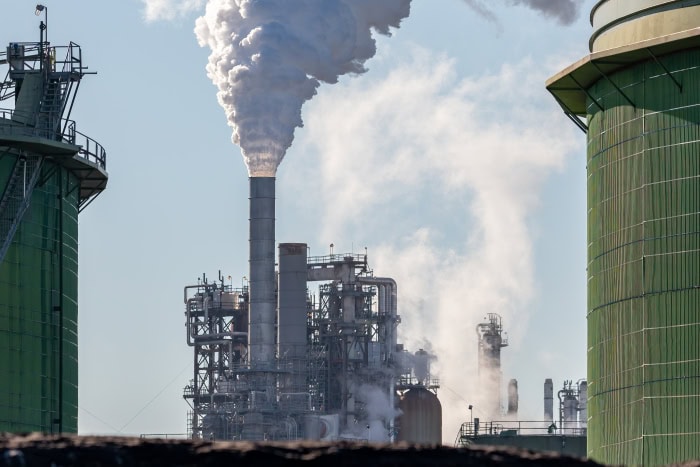
CBAM stands for Carbon Border Adjustment Mechanism and is an EU system aimed at reducing the risk of carbon leakage, meaning that production moves from the EU to countries with less stringent climate legislation. CBAM complements the EU Emissions Trading System (EU ETS).
The system requires that emissions arising from the production of certain imported goods (so-called embedded emissions) are reported. The purpose is to create a level playing field between companies within the EU and companies in other parts of the world.
In an initial phase, CBAM covers, among other things, imports of cement, iron and steel, aluminium, fertilisers, electricity and hydrogen.
Operators covered by CBAM shall report emission data. The data shall be verified by an independent accredited verification body. Verification means that the verification body reviews and assesses whether the reported data are correct and comply with the requirements set out in the CBAM Regulation.
To carry out such verification, accreditation is required. Accreditation means that a national accreditation body has assessed that the organisation has the competence, procedures and impartiality required to perform verification in accordance with established standards and regulations.
Swedac is Sweden’s national accreditation body and accredits verification bodies. Verification bodies in third countries shall apply for accreditation with a national accreditation body within the EU.
Apply for accreditation within CBAM
Do you want to apply for accreditation within CBAM? Read more and apply via the form on our website.
Link to the application (swedac.se)
For applicants from third countries
Do you want to apply for accreditation under CBAM as a verification body established in a third country? Here you can find out how to proceed and which accreditation bodies can grant accreditation.
Swedac receives and assesses applications from third countries.
You can also find information from the European Commission on which national accreditation bodies accept applications for accreditation under CBAM.
Information on CBAM verification rules and accreditation framework (commission.europa.eu)
Contact
If you have any questions regarding accreditation in the area of CBAM verification, please contact: registrator@swedac.se
Frequently asked questions about CBAM
Where can I find information about CBAM and accredited verification bodies?
Here you will find the latest information about CBAM and accredited verification bodies:
Register of accreditations (swedac.se)
European Commission’s information on CBAM (commission.europa.eu)
Read more about the accreditation process and how to submit your application:
Application for accreditation (swedac.se)
The accreditation process step by step (swedac.se)
What requirements apply to an application for CBAM accreditation?
Applications must cover one or more CBAM activity groups as set out in Annex I to Commission Delegated Regulation (EU) 2025/2551. In addition, the verification body must comply with applicable standards and regulations, including:
ISO/IEC 17029
ISO 14065
ISO 14066
ISO 14064-3
Regulation (EU) 2023/956
Commission Delegated Regulation (EU) 2025/2551
No additional requirements apply to applications from third countries, but all verification bodies must comply with the Swedish accreditation regulation (STAFS 2020:1).
Further information on required documentation can be found in Articles 3 and 5 of Commission Delegated Regulation (EU) 2025/2551, as well as on the current page, which also contains requirements and guidance documents. Documentation must be submitted in English to Swedac.
How does the application process work, and which countries are prioritised?
Swedac is now accepting applications under ISO/IEC 17029. You may submit your application via the link or by email to registrator@swedac.se.
Apply for accreditation (swedac.se)
We are currently prioritising applications from Sweden, Ukraine and the United Kingdom. Due to limited resources, we are unfortunately unable to process applications from other countries immediately. Organisations from other regions may either be placed on a waiting list or contact other accreditation bodies listed among EA-listed NABs.
List of accreditation bodies offering CBAM accreditation (european-accreditation.org)
Applications from countries outside the EU
We also accept applications from verification bodies established outside the EU. Each application is assessed individually, including a case-specific risk analysis. Please note that the assessment does not constitute any advance commitment regarding the outcome.
For applications from third countries, Swedac must also establish cooperation with a local accreditation body in your region before we are able to process your application.
How long does the accreditation process take?
The accreditation process for verification bodies typically takes 6–10 months from the receipt of a complete application to the point at which a decision is made. The timeframe depends on the scope and complexity of the application, as well as the verification body’s experience with the applicable standards: ISO/IEC 17029, ISO 14065, ISO 14066, and ISO 14064-3.
If the verification body is applying to extend an existing accreditation in a related area, the process may be reduced to 3–6 months.
What fees apply and how are they calculated?
Application fee: SEK 4 000
Cost estimate (quote):
The quote covers the initial assessment and any supplementary assessment after six months. Travel costs outside Sweden are additional and invoiced at actual cost.
Annual fee:
The fee is based on all planned assessment activities over four years, divided by four. It includes case management, preparation, assessment, follow-up, and a basic fee in accordance with the fee regulation STAFS 2025:3.
Travel costs outside Sweden are additional here as well and invoiced at actual cost.
Estimated costs:
For the application and supplementary assessment: SEK 175,000–500,000, depending on the number of activity groups.
Annual fee: from approximately SEK 125 000 and upwards, depending on the scope of the accreditation.
Requirements and guidance documents
Verification of CBAM
Specific documents for the accreditation scheme
Requirements to be fulfilled for accreditation to be granted
(EU) 2025/2551 | Commission Delegated Regulation (EU) 2025/2551 of 20 November 2025 supplementing Regulation (EU) 2023/956 of the European Parliament and of the Council by specifying conditions for granting accreditation to verifiers, or the control and oversight of accredited verifiers, for the withdrawal of accreditation and for mutual recognition and peer evaluation of accreditation bodies
SS-EN ISO 14065:2021 | General principles and requirements for bodies validating and verifying environmental information
SS-ISO 14066:2025 | Environmental information — Competence requirements for teams validating and verifying environmental information
SS-EN ISO 14064-3:2019 | Part 3: Specification with guidance for the verification and validation of greenhouse gas statements
Regulations requiring that the relevant activity be performed by an accredited body
(EU) 2023/956 | Regulation (EU) 2023/956 of the European Parliament and of the Council of 10 May 2023 establishing a carbon border adjustment mechanism
(EU) 2025/2551 | Commission Delegated Regulation (EU) 2025/2551 of 20 November 2025 supplementing Regulation (EU) 2023/956 of the European Parliament and of the Council by specifying conditions for granting accreditation to verifiers, or the control and oversight of accredited verifiers, for the withdrawal of accreditation and for mutual recognition and peer evaluation of accreditation bodies
(EU) 2025/2546 | Commission Implementing Regulation (EU) 2025/2546 of 10 December 2025 on the application of the principles for verification of declared embedded emissions pursuant to Regulation (EU) 2023/956 of the European Parliament and of the Council
(EU) 2025/2547 | Commission Implementing Regulation (EU) 2025/2547 of 10 December 2025 laying down rules for the application of Regulation (EU) 2023/956 of the European Parliament and the Council as regards the methods for the calculation of emissions embedded in goods
Guidance and recommendations for fulfilling accreditation requirements
SS-ISO 14066:2025 |Environmental information — Competence requirements for teams validating and verifying environmental information
SS-EN ISO 14064-3:2019 | Part 3: Specification with guidance for the verification and validation of greenhouse gas statements
General documents for the conformity assessment activity
Requirements to be fulfilled for accreditation to be granted
SS-EN ISO/IEC 17029:2019 | Conformity assessment — General principles and requirements for validation and verification bodies
STAFS 2020:1 | Swedac’s Regulations and General Guidelines on Accreditation
Guidance and recommendations for fulfilling accreditation requirements
SWEDAC DOC 20:1 | Swedac’s policy for reference to accreditation